DICOMweb Sender
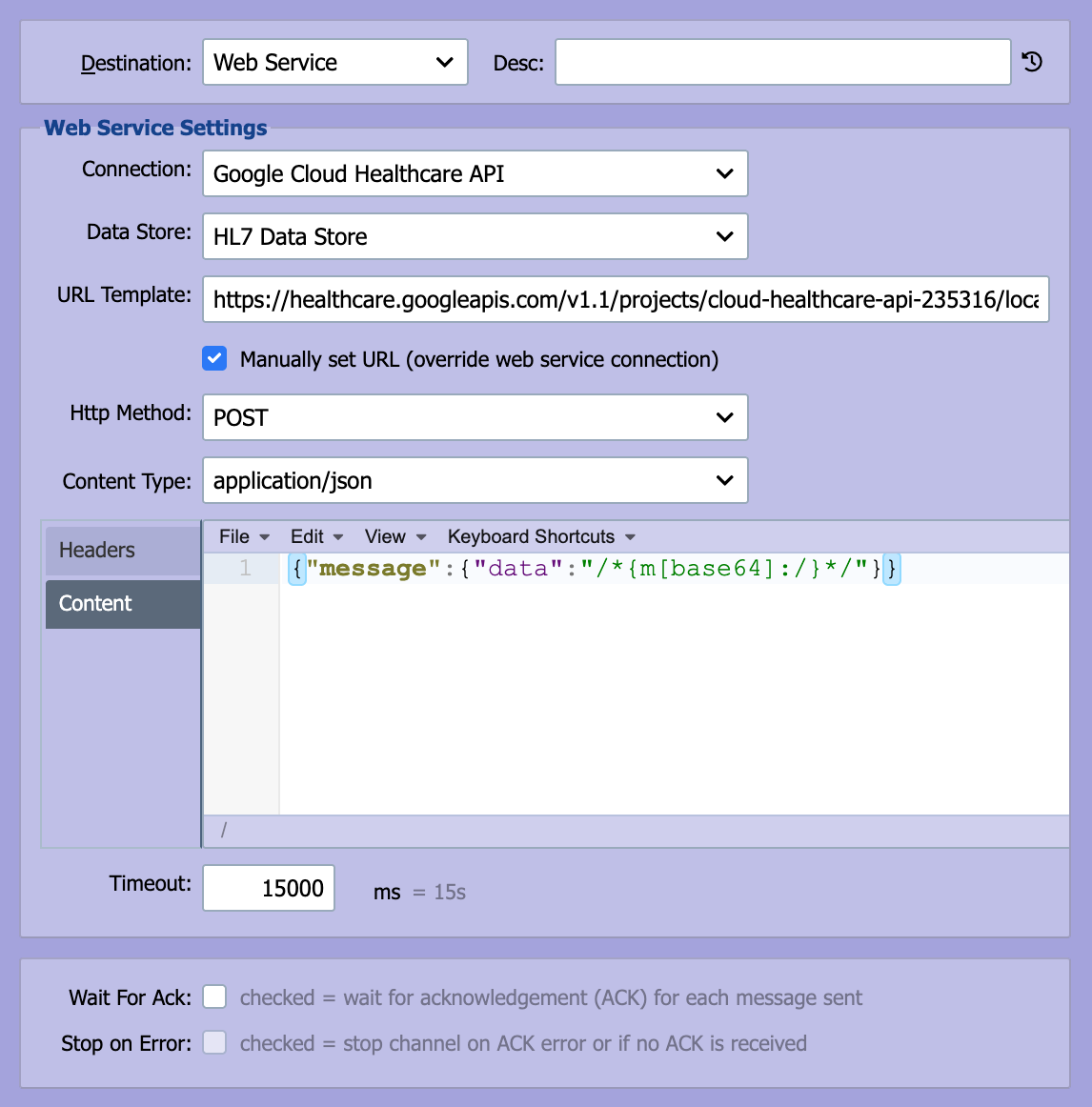
The DICOMweb Sender submits messages to a DICOMweb server, a PACS, VNA, or archive that supports the DICOM web services. It is tied to a DICOMweb Web Service Connection and exposes the standard DICOMweb services as a catalog of named operations.
Operation
Select the DICOMweb operation to invoke from the Operation drop-down. The catalog is grouped by service:
| Service | Operations |
|---|---|
| QIDO-RS (Query) | Search for studies, series, and instances. |
| WADO-RS (Retrieve) | Retrieve studies, series, instances, metadata, rendered images, and thumbnails. |
| STOW-RS (Store) | Store instances to a study or to the archive. |
| UPS-RS (Worklist) | Create, retrieve, update, search, change the state of, and subscribe to Unified Procedure Step workitems. |
Selecting an operation sets its HTTP method, request body shape, and required headers (such as Accept). The endpoint path for the operation is appended to the connection's endpoint URL; path placeholders (for example a study or series UID) are filled from message data using Node Tags (see Node Paths and Node Tags).
Parameters and HTTP Headers
Query parameters and HTTP headers for the selected operation are configured the same way as for a REST sender (see HTTP Headers button). Required headers (including the Accept header that selects the response representation) are pre-populated from the operation definition; edit a value when a server needs a non-default representation.
Note
Per the DICOMweb standard (PS3.18), QIE places non-header parameters in the URL query string for every DICOMweb operation, regardless of HTTP method.
Store (STOW-RS) parts
A STOW-RS store operation sends a multipart/related; type="application/dicom" request whose parts carry the DICOM instances to store. Add one part per instance using the parts editor. For each part, specify the source of the DICOM bytes (typically the message or source node) and the content type (application/dicom). The in-flight message content is commonly the DICOM object being stored.
Timeout
The timeout specifies how long QIE waits for a response from the DICOMweb server before issuing a timeout error and aborting the call.