Supported Message Formats
QIE supports a variety of message data formats, detailed in the table below. Users also have the ability to translate messages and message data from one format to another. QIE includes encoding types of UTF-8, UTF-16, ISO-8859-1 and windows-1252. The default encoding for each message is included in the table.
| Data Format | Description | Encoding |
|---|---|---|
| HL7: Health Level 7 | HL7 is a messaging standard adopted by the healthcare industry for exchanging clinical and financial information between various healthcare IT systems. | UTF-8 |
| ASTM: American Society for Testing and Materials | ASTM is the predecessor to the HL7 message type. | UTF-8 |
| Binary | Binary messages are read in as byte arrays in order to prevent corruption of certain types of objects such as PDF documents. | ISO-8859-1 |
| CSV: Comma Separated Values | A CSV file stores tabular data (numbers and text) in plain-text form organized by rows and columns. CSV is a common, relatively simple file format that is widely supported by consumer, business, and scientific applications. | UTF-8 |
| DB Query Results | QIE can query a database and use the result set of that query as the input to a channel. | UTF-8 |
| DICOM | Digital Imaging and Communications in Medicine (DICOM) is the standard for the communication and management of medical imaging information and related data. | Binary |
| EDIFACT | Electronic Data Interchange for Administration, Commerce and Transport is an international standard for electronic data interchange developed for the United Nations and approved and published by UNECE, the UN Economic Commission for Europe. | UTF-8 |
| Fixed Length | Fixed length is a type of text file with columns having known fixed widths, as compared to a character-separated (CSV) or tabular text file. Many legacy IT systems require that data be formatted in a fixed length format in order to be imported and/or processed. | UTF-8 |
| JSON: JavaScript Object Notation | JSON is a lightweight text-based open standard designed for human-readable data exchange. It is derived from the JavaScript programming language for representing simple data structures and associative arrays, called objects. | UTF-8 |
| Plain Text | Unstructured human readable text. | ISO-8859-1 |
| XML: Extensible Markup Language | XML is a set of rules for encoding documents in a format that is both human-readable and machine-readable. XML has been employed as the base language or format for many communication protocols, such HL7-CDA, SOAP Web Services, XMPP, etc. | UTF-8 |
| X12 (ASC X12) | The Accredited Standards Committee X12 (also known as ASC X12), chartered by the American National Standards Institute more than 30 years ago, develops and maintains EDI and CICA standards along with XML schemas which drive business processes globally. | UTF-8 |
QIE parses these message formats. Each has its own page except the three below, which need no configuration beyond selecting the format.
- HL7 Format
- ASTM Format
- CSV Format
- DB Query Result
- DICOM Format
- EDIFACT Format
- Fixed Length Format
- XML Format
- X12 Format
Binary Format
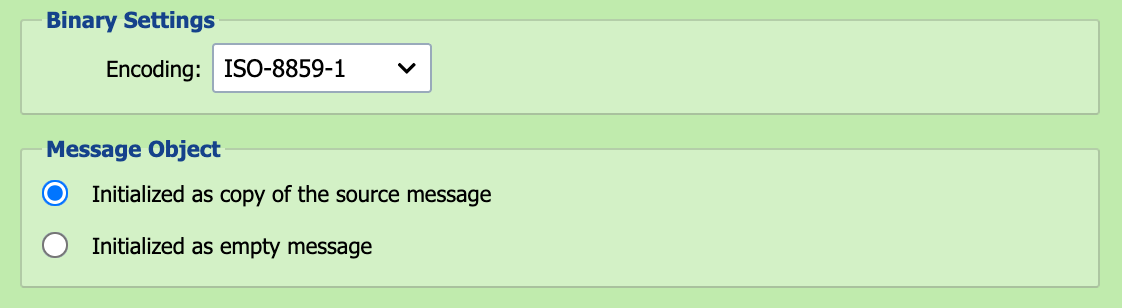
Some object types such as PDF documents are corrupted unless they are read in at the byte level. QIE prevents these types of corruption with the binary message format.
JSON Format

JSON is a lightweight text-based open standard designed for human-readable data exchange. It is derived from the JavaScript programming language for representing simple data structures and associative arrays, called objects. No additional configuration is required in QIE for JSON formatted messages.
Plain Text
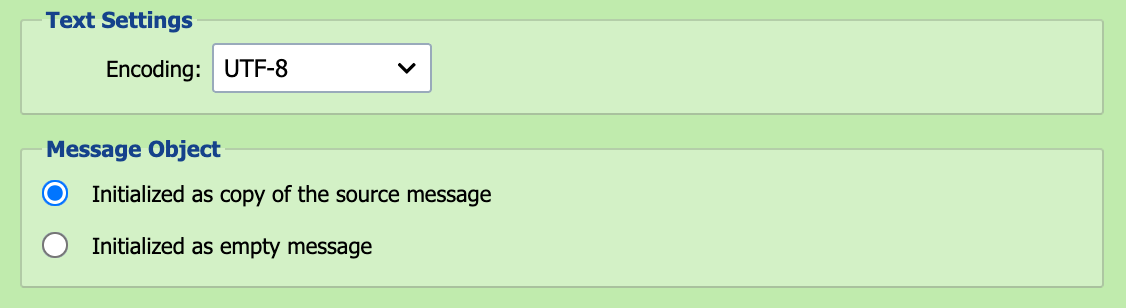
The plain text format is unstructured human readable text. No additional configuration is required in QIE for Plain Text messages.