Fixed Length Format
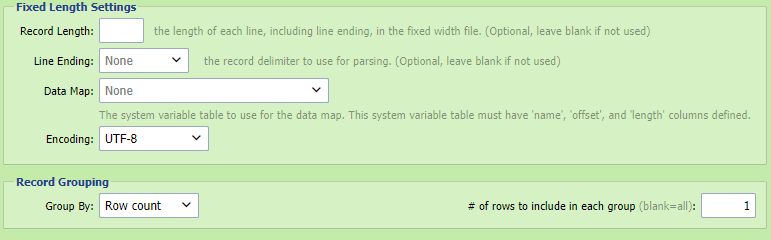
Fixed length is a type of text file with columns having known fixed length, as compared to a character-separated (CSV) or tabular text file. Many legacy IT systems require that data be formatted in a fixed length format in order to be imported and/or processed.
Record Length
For fixed length formats, the record length associated with each row or record must be specified. The 'record length' or the 'line ending' or both must be specified. If the record length is left blank and the line ending is used, then there is no validation on length and you can have records with different lengths. If both the line ending and the record length are specified, then the message is split by line ending, and then each record is validated to ensure that it is the length specified.
Line Ending
The line ending allows you to specify the character that is used to separate each record in the message.
Data Map
The data map can be used so that you can reference nodes in a record by name instead of offset,length annotation. The data map is a System Variable with a minimum of 3 columns labeled 'name', 'offset', and 'length' other columns in the data map are ignored.
Record Grouping
QIE can be configured to group records in a message set based on either column values or row counts. When using the 'Node Value' option, QIE continues adding rows to the current message until it encounters a change in value for the specified node. It refers to the node in the offset,length format. When using the 'Row Count' option, QIE groups the specified number of rows together into a single message. The most common configuration is to treat each row as an individual message.