Remote Management Hub (RMH)
The Remote Management Hub monitors and controls QIE instances running inside separate customer networks from a single console.

The Remote Management Hub monitors and controls QIE instances running inside separate customer networks from a single console.
The Remote Management Hub (RMH) is QIE running in a management mode. Instead of processing messages, it aggregates every QIE site you operate into one dashboard, and lets you open any site’s own administration console from there.
It exists for one reason. Once QIE runs at many sites, on networks you do not control, opening a VPN into each one for routine work stops being practical. RMH replaces that with a single console that reaches every site.
It is the same software your team already knows: the same installer, the same login, the same administration screens, started in a mode that manages other QIE instances rather than running interfaces itself.
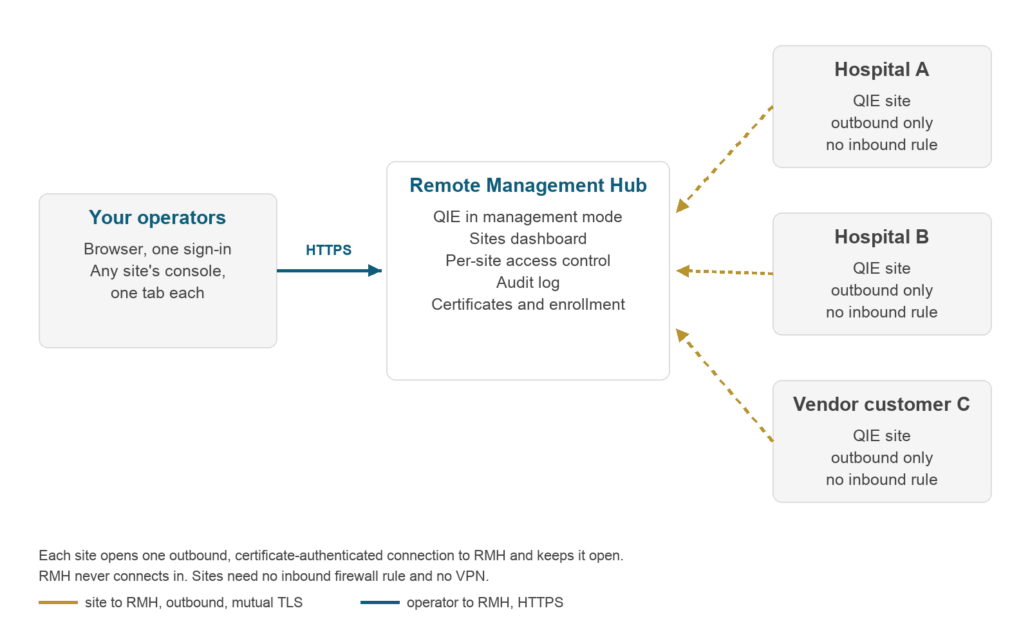
Each QIE site opens one outbound, certificate-authenticated connection to RMH and keeps it open. RMH never connects in. The site’s firewall needs no inbound rule, and nobody needs a VPN. Through that connection RMH receives each site’s status every few seconds and carries your administrative session when you open the site’s console.
RMH carries administrative sessions and status. Interface message traffic never routes through it. Messages continue to flow directly between each site’s QIE and the systems it integrates, exactly as they do without RMH.
The Sites Dashboard lists every registered site and refreshes continuously from each site’s status reports. For each site you see whether it is online, which QIE version it runs, how many channels are running, paused, stopped or errored, its queue depths, and its memory and thread usage. Filter by name, subdomain or tag when the list is long.
To work on a site, select it and connect. Its own administration console opens in a new browser tab, through RMH, and you sign in to it with that site’s own login. Everything you can do in that console when you are on site, you can do from here.
Around that sit the controls a fleet needs: per-site access grants by user or role, an audit log of every meaningful action, certificate management for every enrolled site, and enrollment of new sites.
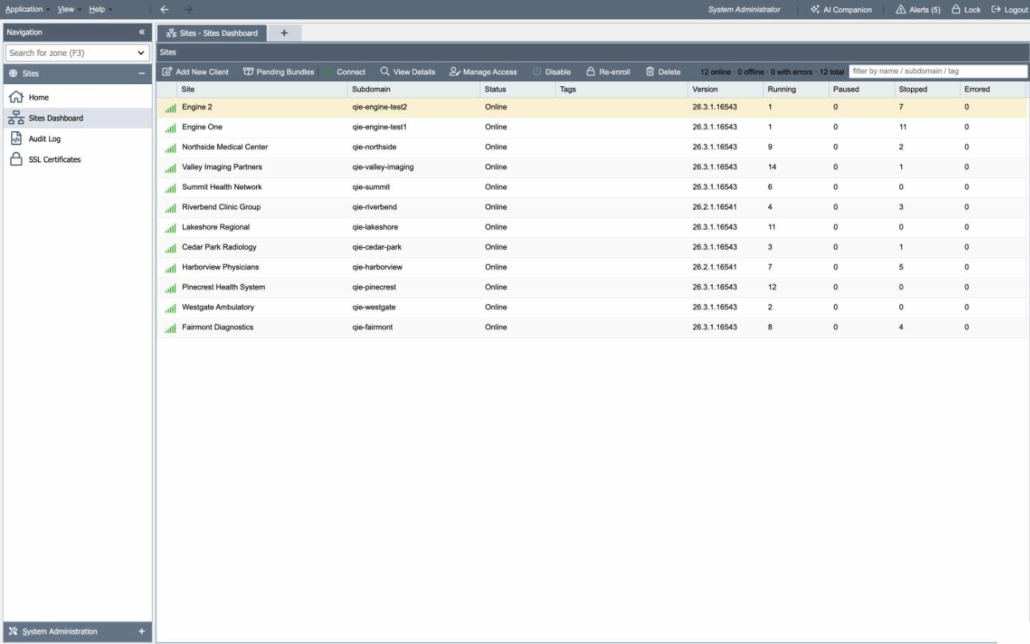
The Remote Management Hub Sites Dashboard.
Enrollment is a one-time, out-of-band handshake. An RMH operator generates a signed, single-use enrollment file and hands it to the site administrator. The file contains no private key. The site generates its own key, proves possession of it, and only then receives its certificate. There is no public sign-up endpoint, so nobody who has not been handed that file by your operator can enroll a site.
From then on, security rests on facts a reviewer can check:
Qvera’s own controls are attested under SOC 2 Type 2. For the attestation and how to request the report, see support and security.

Registering a QIE site with the Remote Management Hub.
Anyone running QIE at many sites, from a regional health system to a software vendor with a fleet of customer installations.
RMH is available with every QIE licensing model. It is not limited to vendor deployments.
Yes, and the difference is the network. A monitoring console shows you the status of engines you can already reach. RMH gives you a working administrative session into engines on networks you cannot reach, without a VPN to each one, because every site connects out to RMH rather than RMH connecting in.
Status is part of it, and the dashboard shows it. But the thing that changes how a team works is being able to open any site’s console from one place and act.
RMH manages QIE. For how QIE compares with other engines, including their management consoles, see Mirth Connect alternatives.
RMH is QIE, started in management mode, so it runs wherever QIE runs: on-premise, in containers, or in your own cloud on AWS, Azure or Google Cloud, against MSSQL, MySQL or MariaDB. It needs a hostname and a wildcard TLS certificate, because each site’s console is opened on its own subdomain so that browser sessions to different sites stay isolated from each other.
For high availability, several RMH nodes run behind a load balancer against a shared database. If a node fails, its sites reconnect to a surviving node on their own, and operators keep working.
The Remote Management Hub is available as an add-on to any plan. It is licensed separately from QIE itself and works with all three QIE licensing models: per-channel, Enterprise and OEM.
An RMH license is sized by the number of sites you register with it. Prices in USD. Final pricing is confirmed with Qvera sales.
QIE is in production today at more than 600 sites, running more than 25,000 interfaces and processing more than 50 million messages a day. Individual deployments range from a single clinic to more than 10 million messages a day in a single QIE instance.
Qvera has built healthcare integration engine software since 2008. Support is by email and phone, with a dedicated account representative and 24/7 coverage for system-down emergencies.