CASE STUDY

CASE STUDY
Nexus Health Systems moved its production interfaces from iNTERFACEWARE Iguana to the Qvera Interface Engine (QIE) without rewriting them and without interrupting message flow, using QIE’s built-in AI Companion to port its existing Lua scripts to JavaScript.
Changing interface engines can feel like a major undertaking. Existing integrations, custom scripts and years of accumulated logic make the idea of moving to a new platform look disruptive and slow. The work already invested is real, and nobody wants to spend it twice.
For Nexus Health Systems, a Houston-based health system, the move took less effort than the team expected — little enough that an integration project already on the schedule was never held up by it.
Download as PDF
As Nexus evaluated the long-term direction of its interoperability environment, the team needed three things at once: flexibility in how and where it runs, real depth in healthcare integration, and the ability to move quickly.
Speed mattered more than it usually does. Nexus had an immediate integration project that needed to go forward, and a migration measured in quarters would have stalled it.
Four things shaped the decision:
This is the first question every Iguana site asks, and it was the largest single piece of work in the migration. Interface logic in Iguana is written in Lua; QIE scripts in JavaScript. Rather than rebuild the interfaces from scratch, Nexus used its existing Lua as the starting point.
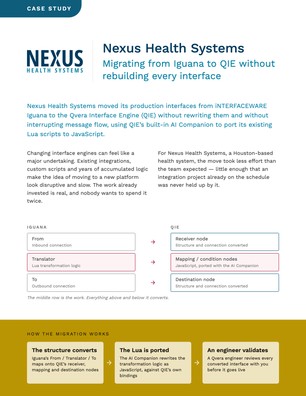
An Iguana-to-QIE migration has four parts:
The middle row is the work. Everything above and below it converts.
One thing does not come across. Connection credentials are encrypted in an Iguana export, so they are re-entered in QIE by hand on every migration and belong on the cutover checklist from the start.
All the interfaces Nexus ran in Iguana now run in QIE, supporting production workflows. The channel structure and connection configuration converted; the Lua transformation logic was ported to JavaScript with the AI Companion rather than rewritten from a blank editor, and a Qvera engineer validated each one before it went live.
The practical effect was that requirements gathering — normally the longest part of building an interface — was largely unnecessary, because the existing Lua already documented what each interface did.
Nothing stopped. Nexus moved the interfaces incrementally rather than in a single switchover, so at no point did the whole estate depend on one cutover working. The systems Nexus feeds saw no interruption in service.
For a health system that is the whole point: the platform underneath the data changed, and the data kept moving.
“Our biggest concern going in was how much of our existing Iguana work would have to be redone. It was a much smaller lift than we thought. Our existing Lua code already defined what each interface needed to do, and the AI Companion handled the bulk of translating that into QIE scripts. Every interface is now running in production, with effectively no downtime.”
Josh Atchley – Senior Manager, Platform & Infrastructure – Nexus Health Systems
ABOUT NEXUS HEALTH SYSTEMS
Since 1992, Nexus Health Systems has provided specialty care for patients with medical, behavioral and psychiatric needs. With a network of hospitals and medical-model residential treatment centers across Texas, Nexus serves children, teens and adults facing some of the most challenging diagnoses — including autism and related neurodevelopmental disorders, Prader-Willi Syndrome, neurological injuries and illnesses, and other medically complex conditions. Its interdisciplinary teams deliver fully integrated, whole-person care.
Produced by Qvera | www.qvera.com | © 2026